
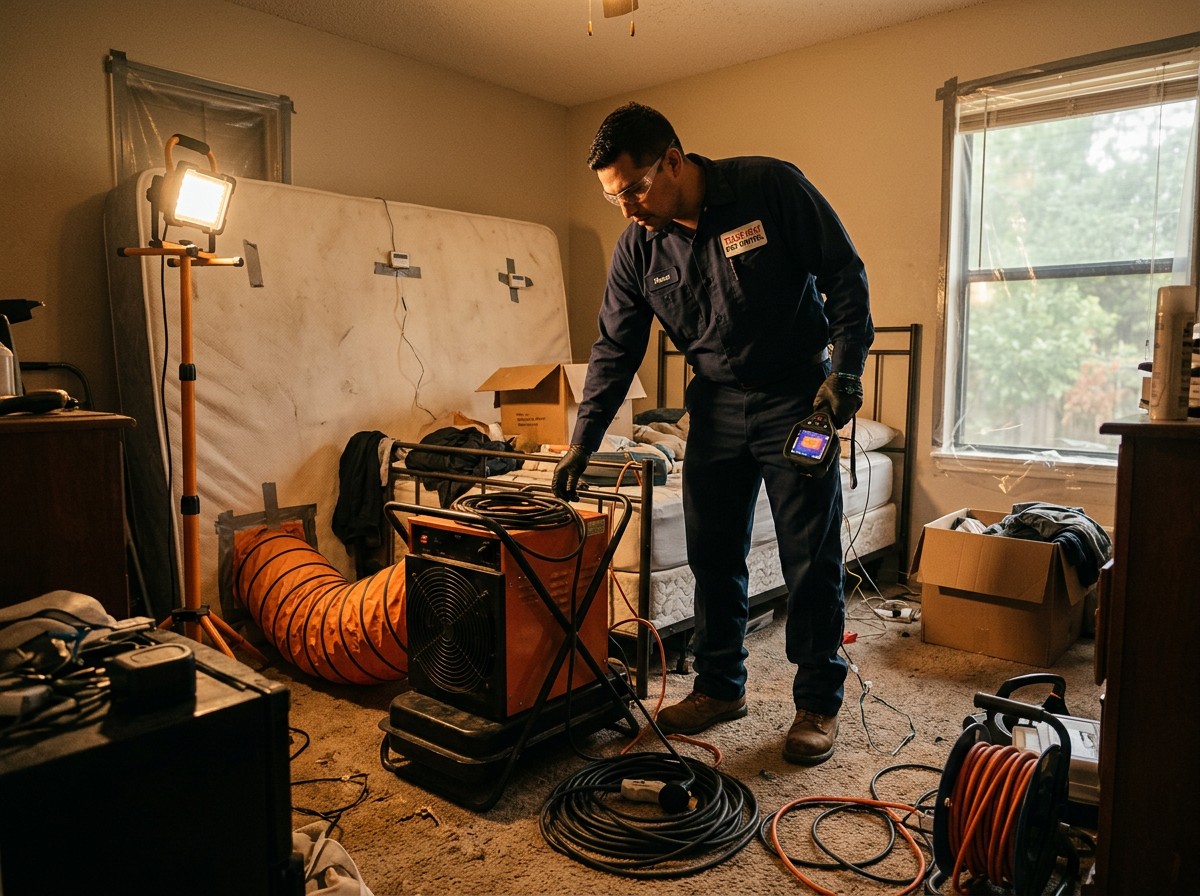
Bed bugs move easily through wall voids and utility chases in Texas multi-family housing, so heat treatment must cover the entire space rather than isolated spots. Technicians set up industrial heaters and place wireless sensors on floors, behind baseboards, inside box springs and within wall voids to confirm every zone holds at 120 degrees Fahrenheit for at least four hours. This single-visit approach kills eggs that most chemical products miss, though reintroduction remains possible if items are brought in afterward.
Preparation determines success more than the equipment itself. Residents must remove candles, aerosols, vinyl records, certain electronics and plastics that can warp or ignite, then bag and launder remaining fabrics on high heat. Furniture is pulled away from walls and clutter reduced so hot air circulates freely. In Tomball homes near older subdivisions, technicians often find infestations concentrated along baseboards and in nightstands where travel along I-45 corridors brings new introductions during student move periods.
Bed Bug Heat Treatment Near You — Choose Your City
Every city below has its own local Bed Bug Heat Treatment page with coverage details.
Harris County
Harris
Fort Bend
Burnet County
Austin County
Collin County
Hood
Montgomery
Bexar County
McLennan County
Travis County
Kendall
Hays
McLennan
Williamson
Grayson County
Bell
Parker
Hunt
Wharton
Hopkins
Williamson County
Cherokee County
Houston
Lamar County
Somervell County
Brazoria
Rains County
Ellis
Lampasas County
Walker
Jack
Hunt County
Waller County
Brazoria County
Comal
Montgomery County
Bastrop County
Guadalupe County
Dallas County
Galveston County
Denton County
Tarrant
Medina County
Verification follows the heat cycle once temperatures return to normal. Technicians inspect seams, headboards and box springs for live bugs or shed skins, then place interceptors to monitor for any activity over the next weeks. Heat leaves no residual, so neighboring units or newly acquired furniture can restart the cycle if left unaddressed. The method suits single-family homes and apartments when preparation is complete and adjoining spaces are coordinated.
Technician insight
In Tomball the thing that catches most people out with Bed Bug Heat Treatment is older single-story homes along the I-45 corridor where wall voids run straight into the attic; if you do not pull every piece of furniture off the walls and bag items before we arrive, the sensors show cold pockets and the job stretches into a second day.
Tomball Duplex Heat Treatment
A duplex near the Tomball service center showed activity in one unit along baseboards and the headboard. Sensors placed in the shared wall void revealed heat was not reaching the neighboring side. Heaters were added to both units, sensitive plastics removed, and the full space held at temperature. Follow-up interceptors remained clear after two weeks.
Bed Bug Heat Treatment Services We Offer
✓Whole-Room Thermal Treatment
Industrial heaters raise the full interior to lethal temperatures that penetrate mattresses, furniture and wall voids in one session.
✓Sensor-Monitored Holding
Wireless probes track core temperatures in multiple zones to confirm every area maintains required heat for the full exposure period.
✓Heat-Sensitive Item Removal Guidance
Technicians identify and direct removal of candles, aerosols, vinyl records, plastics and sensitive electronics before heaters start.
✓Post-Treatment Verification
Detailed visual checks of seams and harborages plus interceptor monitoring confirm results after the space cools.
✓Multi-Unit Coordination
Treatment plans extend to adjoining apartments to prevent reinfestation through shared voids when one unit is addressed.
✓Preparation Planning Session
On-site review covers bagging, laundering, decluttering and furniture movement required for effective air circulation.
How it works
- 1
Initial Assessment
Technicians inspect seams, box springs, headboards and baseboards to map the full extent before equipment arrives.
- 2
Item Removal and Prep
Heat-sensitive belongings are removed and remaining fabrics are bagged or laundered according to the plan.
- 3
Heat Application
Heaters and sensors are positioned; temperatures are raised and held across all monitored zones for the required duration.
- 4
Verification and Monitoring
Post-cool inspection and interceptor placement track any remaining activity over following weeks.
Pricing
Scope depends on square footage, number of rooms and whether adjoining units require coordination; call for an inspection-based quote.